Dr Jay Doorga is my classmate at Oxford Environmental Change and Management (ECM) Programme. He and Priyal are the first two Mauritians admitted to the programme since its establishment over 20 years ago. Jay has always inspired me with his research rigour, intelligence and diligence. Little did we realise he was completing a PhD at the same time of our MSc programme, and he graduated with both a PhD degree and a distinction in our MSc course! If that’s not impressive enough, Jay won the annual Oxford ECM Publication Award for his master thesis with Professor Jim Hall and Professor Nick Eyre on guiding investments in solar and wind in Africa.
We have maintained our friendship after the programme ended, constantly exchanging research ideas and looking for ways to foster closer collaboration on Asia-Africa studies on energy decarbonisation and climate change.
One day, Jay asked if I am interested to collaborate on his research on waste management in Mauritius. I was reluctant at first because I have very limited knowledge about the island state. However, Jay reminded me of the similar challenges encountered by Mauritius and Hong Kong on solid waste treatment. After this research, I could attempt to apply similar methodology to plan the waste treatment pathway for Hong Kong in the future.
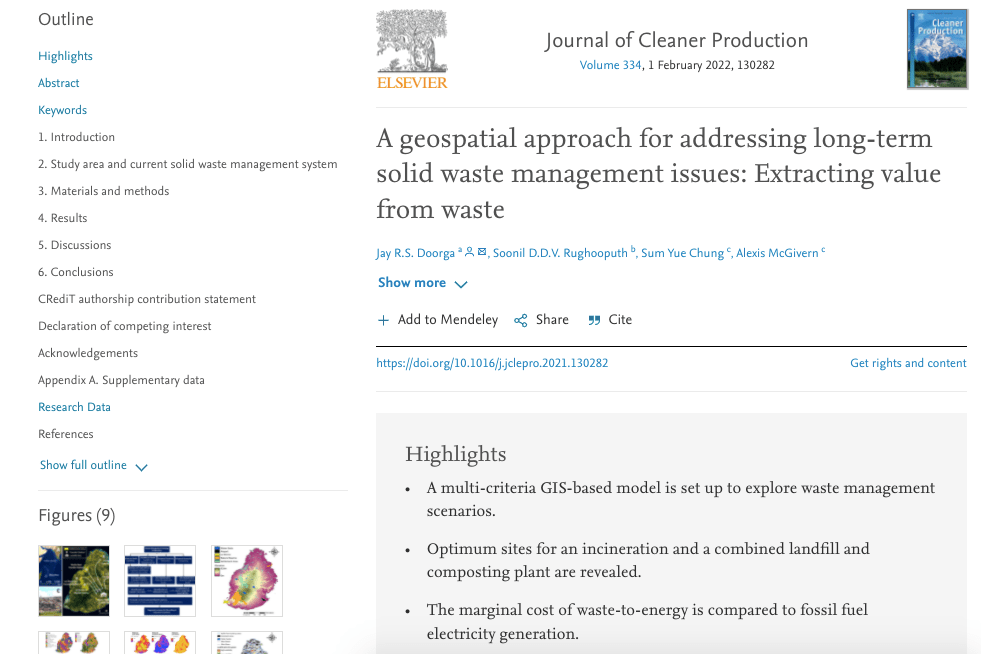
Eventually, Jay published the research on Journal of Cleaner Production, entitled “A geospatial approach for addressing long-term solid waste management issues: Extracting value from waste”. I would not claim any credits as a co-author, because all I did was offering comments from a social science perspective. But I was more than delighted that this collaboration may lead to more joint-research moving forward in areas we can share best practices and generate synergies.
Through geospatial analysis, the research explores the best site for solid waste treatment facility of the island and the potential of generating clean energy from the waste. It offers important insight for other countries in the world to best leverage waste-to-energy and recycling facilities. This experience has again proved to me, the world is so unnervingly large but still tightly interconnected.
The paper can be accessed via the link below: https://www.sciencedirect.com/science/article/abs/pii/S0959652621044474
 Natalie Chung 鍾芯豫