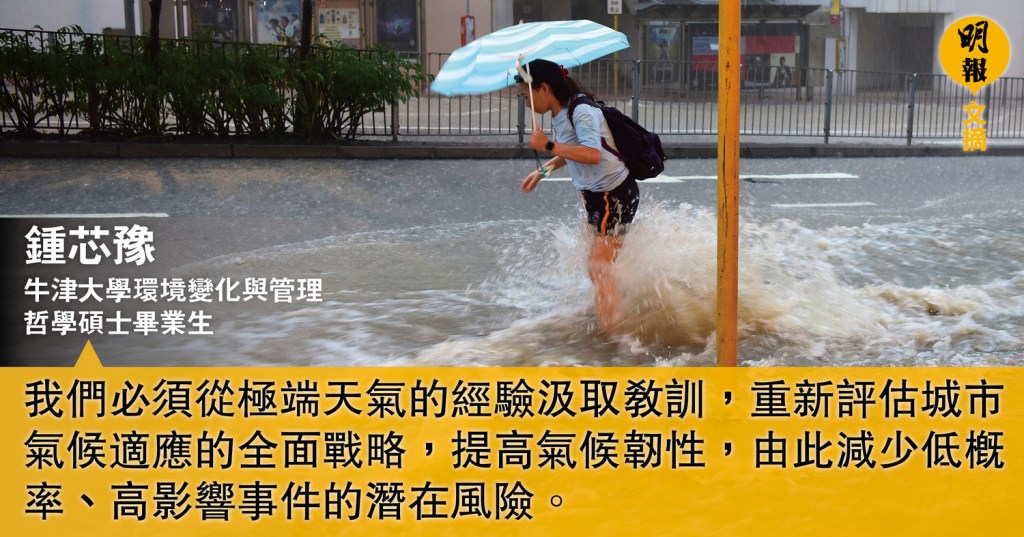
Calling the summer of 2023 in Hong Kong eventful would be an understatement. The city witnessed the hottest August on record, marked by multiple heatwaves. In September, Super Typhoon Saola struck, followed closely by a severe rainstorm – during which the highest hourly rainfall since 1884 was recorded – that caused serious flooding.
Scientists have concluded – with very high confidence in reports by the Intergovernmental Panel on Climate Change – that anthropogenic climate change is responsible for the increasing intensity and frequency of such extreme weather events. While Hong Kong has prided itself on its strong infrastructure and transport networks, these events present growing challenges to the city’s urban climate resilience.
Drawing on my research experience on climate resilience through bodies of literature including “The Palgrave Handbook of Climate Resilient Societies” by Soulodre and Kesavan (2020), I penned an op-ed on SCMP and Ming Pao sharing my views on how Hong Kong can embrace a suite of hard infrastructure and nature-based solutions to enhance the climate resilience of our urban environment. Community resilience is another fundamental component of resilience that is often neglected.
Being a low-lying coastal city with a subtropical monsoon climate, Hong Kong is highly vulnerable to extreme weather events. However, the sense of climate emergency has not been effectively translated into policymaking and public education. We must learn from our painful experiences and reassess our adaptation strategy to enhance climate resilience.
This is crucial to minimise the looming risks associated with low-probability, high-consequence events that are becoming higher-probability events thanks to climate change. A climate-resilient society will enable different stakeholders to withstand and recover from such stress.
To construct a more climate-resilient urban environment, Hong Kong must review and improve its approach to addressing extreme weather events. The most significant deficiency in Hong Kong society, as revealed by recent extreme events, lies in its lack of robustness, and a forward-thinking and reflective mindset.
Read full article on SCMP:
How Hong Kong can best build climate resilience
Ming Pao:
香港遇世紀暴雨 反思城市氣候韌性(文:鍾芯豫)
References:
Soulodre, L., & Kesavan, V. (2020). Climate and Reputation Risks in an Asian Century. The Palgrave Handbook of Climate Resilient Societies, 1-70.
Record high rainfall in HK: https://www.info.gov.hk/gia/general/202309/08/P2023090800080.htm
Hong Kong’s climate adaptation plan commentary: https://www.ccinnolab.org/en/AhTanBlogPost/ahtanblog58
New York Flood Map: https://experience.arcgis.com/experience/6f4cc60710dc433585790cd2b4b5dd0e
 Natalie Chung 鍾芯豫