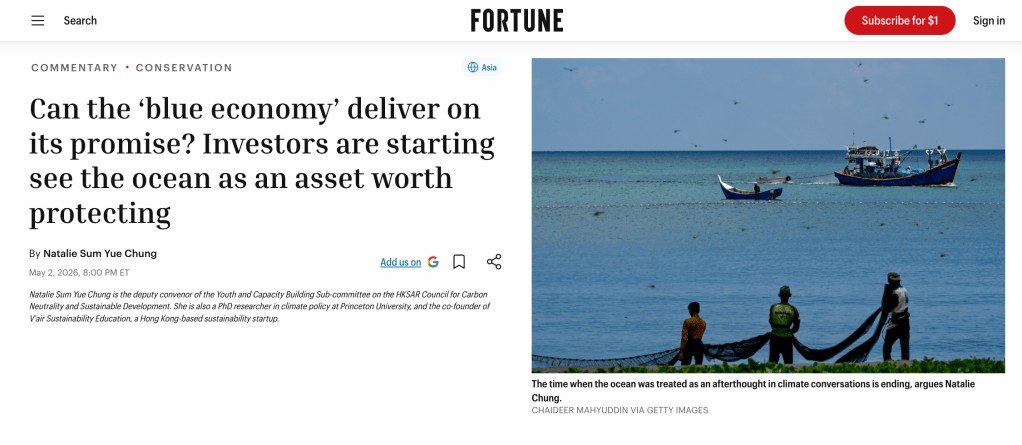
I am delighted to share that my latest magazine article is now live, titled “Can the ‘blue economy’ deliver on its promise? Investors are starting to see the ocean as an asset worth protecting.”
For years, the term “blue economy” has floated somewhere between genuine innovation and convenient buzzword. What does it actually mean? Is it conservation dressed in corporate language? A new frontier for extraction? Or something genuinely transformative? These are the questions I set out to answer by looking closely at what is actually happening on the ground – and in the balance sheets – of ocean‑focused projects.
The piece draws heavily on my time at the Villars Ocean Forum, where a critical mass of investors, scientists, and community leaders have stopped asking whether the blue economy is real and started asking how fast they can scale it. The old, linear model of science‑to‑policy‑to‑philanthropy has failed. In its place, I observed a simultaneous, cross‑sector approach: scientists collecting data that feeds directly into corporate disclosure frameworks like the TNFD, investors using that data to price risk and structure blue bonds, and local communities operating monitoring stations and receiving revenue.
Two core arguments in the article
First, the scientific debate is effectively over. Professor Tim Lenton reminded the forum that more than 84 percent of the world’s warmwater coral reefs have already tipped into irreversible dieback, directly affecting 500 million people. Scientists also warned that the Atlantic Meridional Overturning Circulation (AMOC) may be at risk of collapse – an event that would freeze European capitals and disrupt monsoons in West Africa and India. The conversation at Villars moved swiftly from diagnosis to deployment. The question was no longer “is this happening?” but “who is already fixing it, and how do we fund them?”
Second, capital is now flowing into verifiable, living‑system projects that demonstrate the blue economy in practice. One example I highlight is a coral restoration project in the Caribbean, funded by a blue bond issued through a multilateral development bank. The project generates verifiable carbon and biodiversity credits, and it employs former fishers as reef stewards – transforming extractors into paid custodians. That risk‑adjusted yield is already attracting family offices and impact funds. It is a concrete case of the blue economy delivering beyond the buzzword.
Gratitude
I owe a very warm thank you to my editor, Nicholas Gordon, whose incisive feedback pushed me to reframe the piece from a personal narrative into a sharper, third‑person expert commentary. You encouraged me to write not as a reporter, but as a commentator and an expert in my own right. The final article is far stronger because of that guidance.
I am also deeply grateful to the Villars Ocean Forum and the entire Villars Institute community for hosting such a grounded, urgent, and cross‑sector conversation. It was a rare space where marine biologists, glaciologists, corporate sustainability officers, investors, explorers, and local leaders shared risks and data – not just slides.
And a special thank you to Keith Tuffley, board member of the Villars Institute, for your leadership and vision in convening a group of people who are actually building something positive for sustaining the ocean, the blue heart of our planet. That made all the difference.
Read the full article
You can read the complete magazine article here: https://fortune.com/2026/05/02/can-blue-economy-deliver-promise/
I hope it offers a useful perspective on where the blue economy stands today – and where it might go next. I would welcome your thoughts and comments, whether you see this as a genuine breakthrough or a work in progress.
 Natalie Chung 鍾芯豫